

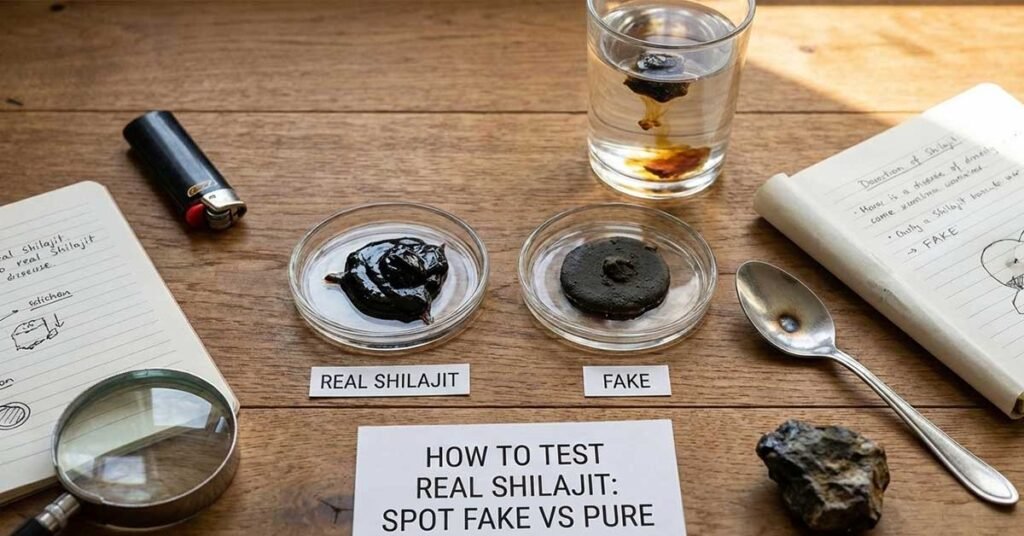
The jar says “pure,” but does it really? Time to find out. Some are watered down, others stuffed with fillers (cheap additives), and most barely do anything at all. Spotting the real Shilajit before it hits a daily routine saves money, time, and a lot of frustration. The authentic resin delivers energy, focus, and stamina that fake versions simply cannot. Keep reading and the full truth becomes obvious.
Real Shilajit is dense, sticky, and malleable. A tiny bit should feel heavy for its size and slowly soften at room temperature. Drop it on a table and it sticks. Rub it lightly between fingers and it softens gradually, leaving a faint mineral trace on the skin.
Fake or diluted Shilajit often fails this test. Some versions crumble like chalk, others feel waxy or rubbery. Certain cheap products try to mimic texture by adding resins from unknown sources. That can look convincing, but a simple touch tells the truth. Sticky, malleable, slightly resistant, that’s the texture of Himalayan resin that’s been harvested, aged, and preserved naturally.
Himalayan Shilajit is naturally dark brown to black, sometimes with a reddish or golden sheen depending on mineral content. It isn’t glossy or unnaturally uniform. If the resin looks like black tar or shiny plastic, it has likely been overprocessed or blended with artificial fillers.
Color can be subtle, so pay attention to minor variations. Deep earthy tones, a slight sheen, and a natural gradient all indicate real resin. Uniform black without variation is a red flag. The color tells the story of mineral richness and authenticity, long before opening the jar.
One of the easiest ways to spot real Shilajit is with water. Take a pea-sized portion and drop it into a glass of warm water or milk. Pure Shilajit dissolves slowly, leaving a gentle golden-brown tint. No chunks remain, and nothing floats unnaturally.
Fake or diluted versions often dissolve too quickly or leave residue that looks like sediment. Some synthetic versions just float or stick together in lumps. Real Shilajit integrates gradually, releasing minerals and fulvic acids naturally. That slow dissolve is a subtle but powerful sign of authenticity.
Real Shilajit has a strong, earthy aroma with hints of smokiness and mineral depth. It tastes bitter, heavy with natural minerals. Overly sweet or bland Shilajit, or anything with chemical undertones, is almost always fake.
Taste and smell are natural filters. If it’s missing the bitterness or earthy heaviness, the jar likely contains added substances to mimic the original look. Authentic resin never hides behind flavor tricks.
Lab testing is proof that a jar delivers what it promises. Certificates should show fulvic acid percentage, mineral content, and absence of heavy metals or contaminants. Some brands claim purity without showing reports. Those are the ones to question. Every drop of real Himalayan resin has measurable minerals and compounds. Verified testing ensures the benefits aren’t lost to dilution or fillers.
Where Shilajit comes from is critical. High-altitude regions like Hunza in Pakistan produce resin naturally rich in minerals. Lower-altitude or industrially sourced Shilajit often needs heavy processing, which strips nutrients and reduces effectiveness.
Knowing the source also matters for safety. Himalayan peaks are harsh and untouched. Resin harvested from these areas is naturally pure, aged by time, and minimally processed. The source is a natural guarantee of quality before lab results even come into play.
Packaging is more than aesthetics. Pure Shilajit requires airtight, dark containers to preserve potency. Cheap, transparent plastic jars invite light, air, and degradation. Sturdy, minimalistic, and professional packaging is a small but critical sign of authenticity.
Look for consistency in branding, clear labeling, and protective seals. If the jar feels flimsy or overly decorative, it’s likely more style than substance. Real Shilajit doesn’t need to shout.
If the price feels too good to be true, it usually is. Pure Himalayan Shilajit is rare, labor-intensive, and cannot be mass-produced cheaply. Dirt-cheap jars often contain diluted or synthetic resin. Real resin justifies the price. Low prices signal compromises, usually in potency and purity.
Some quick home checks help detect fake resin:
These are simple tests, but they reveal a lot about what’s inside the jar. Combined with texture, taste, and lab verification, they form a reliable authenticity checklist.
Choosing the right brand eliminates much of the guesswork. Reliable brands provide transparent sourcing, lab verification, and testimonials that describe real-life energy, focus, and stamina improvements. Empty promises and exaggerated claims are a sign to look elsewhere.
GB Shilajit, sourced from Hunza’s untouched Himalayan peaks, delivers mineral-rich resin verified through lab testing. Every jar promises the real benefits of authentic Shilajit: energy, resilience, focus, and overall wellness. Choosing carefully ensures every dose supports health as nature intended, without compromises from dilution or artificial additives.
Spotting fake Shilajit doesn’t require a lab coat. Texture, color, solubility, taste, smell, lab reports, packaging, price, and source tell the story. Authentic resin delivers slow-melting, mineral-rich energy that no fake or diluted product can match. GB Shilajit guarantees this through careful sourcing, testing, and minimal processing. Every drop is real, effective, and exactly what Himalayan Shilajit is meant to give.
